


When autumn arrives, Korea's fields take on a different color in every corner. Pink muhly, silver grass, and yellow and red chrysanthemums fill the landscape from Seoul all the way to Jeju. A hill that was once a landfill, an ancient Silla observatory, a harbor that smells of the sea, and a volcanic-stone path beneath Hallasan Mountain. Many of Korea's autumn flower fields drape a new season over very old scenery. From parks you can reach by subway in the heart of the city to gardens in the south you'll reach by KTX or plane, shall we follow 6 pink muhly spots and autumn flower destinations in Korea together?
Blog
Best eSIM Picks
Korea Pink Muhly Spots and 6 Autumn Flower Destinations
Updated: October 29, 2026
Korean Autumn Pink Muhly Field, Hero Shot

Korea Pink Muhly Spots
and 6 Autumn Flower Destinations
"Where can you see pink muhly
and autumn flowers in Korea?"
and autumn flowers in Korea?"
PICK 1
From Landfill to Silver Hill,
Seoul's Haneul Park
Seoul's Haneul Park
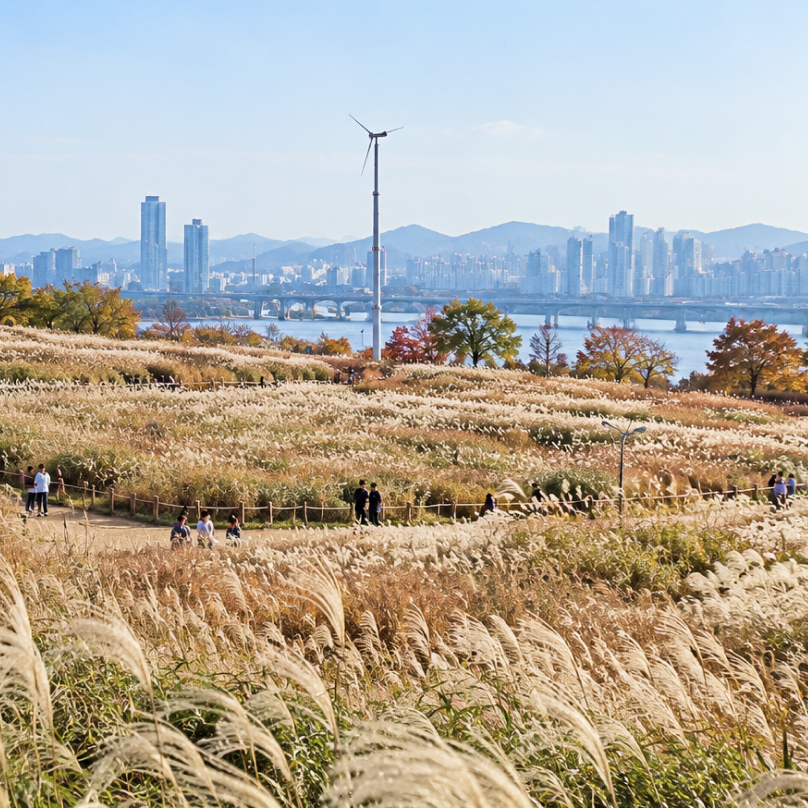
Walk about 15 minutes from World Cup Stadium Station and a hill rises in front of you. Climb the 291 steps of the Haneul Stairs or hop on the "Maengkkongi" electric shuttle, and a silver grass field of about 60,000 pyeong (roughly 200,000㎡) spreads across the 98m summit. From 1978, this hill was the Nanjido landfill, where Seoul buried its trash for 15 years. Ecological restoration began with the 2002 FIFA World Cup, and today Haneul Park (하늘공원) is a hill where silver waves ripple every autumn. Every October, the Seoul Silver Grass Festival (서울억새축제) is held here, with silver waves by day and illuminated grass fields by night. The colorful kochia (summer cypress) field across from the silver grass and the cosmos field on one side of the park are also popular photo spots, so be sure to look around. As the sun sets, the silver plumes turn gold, and the Han River and downtown Seoul open up before you. On the way down, take a walk along the 1km Metasequoia Forest Trail on the south side of the park and wrap up your autumn among the reddening trees.
Location
- 하늘공원(Haneul Park): 서울 마포구 하늘공원로 95
Hours
- Winter season (Oct–Mar) 06:00–21:00
- Open year-round
- 2026 Seoul Silver Grass Festival(서울억새축제): Oct 17–23 (10:00–21:00)
Admission
- Free admission
- Maengkkongi electric shuttle: KRW 2,000 one way / KRW 3,000 round trip
Getting There
- Line 6 World Cup Stadium Station (월드컵경기장역) Exit 1 → 15–20 min walk to the Haneul Park parking lot
- Climb the Haneul Stairs (291 steps) or take the Maengkkongi electric shuttle to the top
Suggested Route
- Stroll the silver grass field at the summit
- Kochia field and cosmos field across from the silver grass
- Han River and downtown Seoul views at sunset
- Metasequoia Forest Trail on the south side after descending (about 1km)
- Kochia and cosmos field locations are based on the 2025 festival
PICK 2
Pink Waves Beside a Baekje Earthen Fortress,
Seoul Olympic Park
Seoul Olympic Park
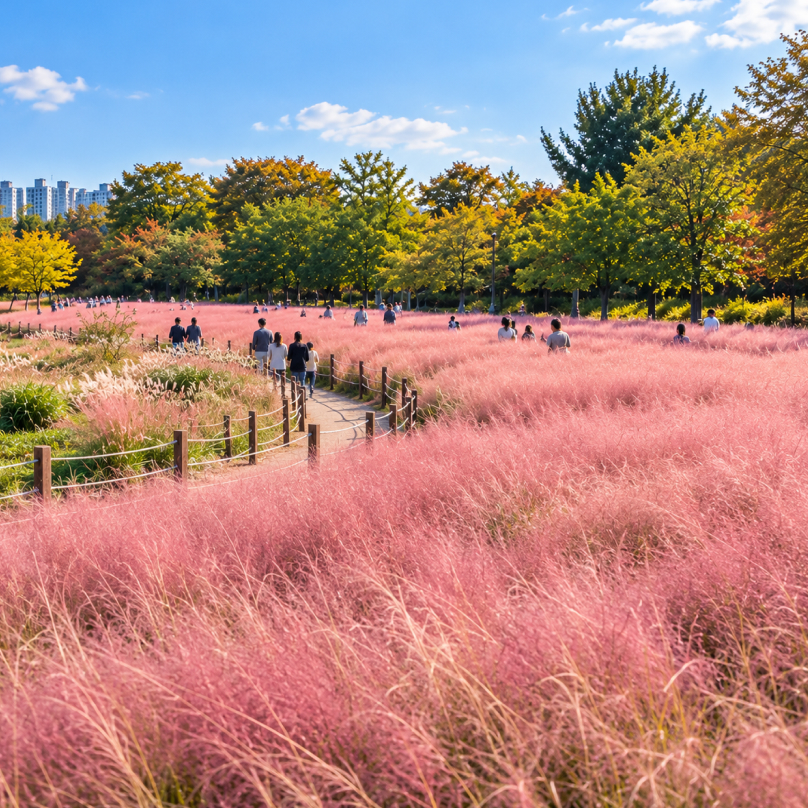
Walk a little over 10 minutes from Exit 2 of Hanseong Baekje Station, and a pink mist appears, hanging low between wide grassy hills. Olympic Park (올림픽공원), opened in 1986 for the 1988 Seoul Olympics, spreads stadiums and sculptures across about 430,000 pyeong (roughly 1.4 million㎡). At its heart lies Mongchontoseong (몽촌토성), a restored earthen fortress built during the Baekje period. Between the legacy of the modern Olympics and this Baekje fortress, the pink muhly in the wildflower garden stays green all summer, then turns soft pink and purple in autumn. Kochia and chrysanthemums grow alongside the pink muhly as well. Pink muhly in the Seoul metropolitan area lasts from mid-October to early November, taking on a lovelier hue as autumn deepens. Continue on to the pampas grass at the 88 Lawn and the "Lone Tree" on the Mongchontoseong trail, and half a day will fly by. Since there's no admission fee, why not stop by in the late afternoon and watch the sun set over the fortress?
Location
- 올림픽공원(Olympic Park, Wildflower Garden): 서울 송파구 올림픽로 424
Hours
- 05:00–22:00 (for pedestrians and cyclists)
- Open year-round
- Plaza areas open until 24:00
Admission
- Free admission
Getting There
- Line 9 Hanseong Baekje Station (한성백제역) Exit 2 → about 10 min walk to the wildflower garden
Suggested Route
- Pink muhly in the wildflower garden
- Pampas grass at the 88 Lawn
- Sunset at the Mongchontoseong trail and the "Lone Tree"
PICK 3
Pink Blooms Against Cheomseongdae,
Gyeongju's Dongbu Historic Site
Gyeongju's Dongbu Historic Site
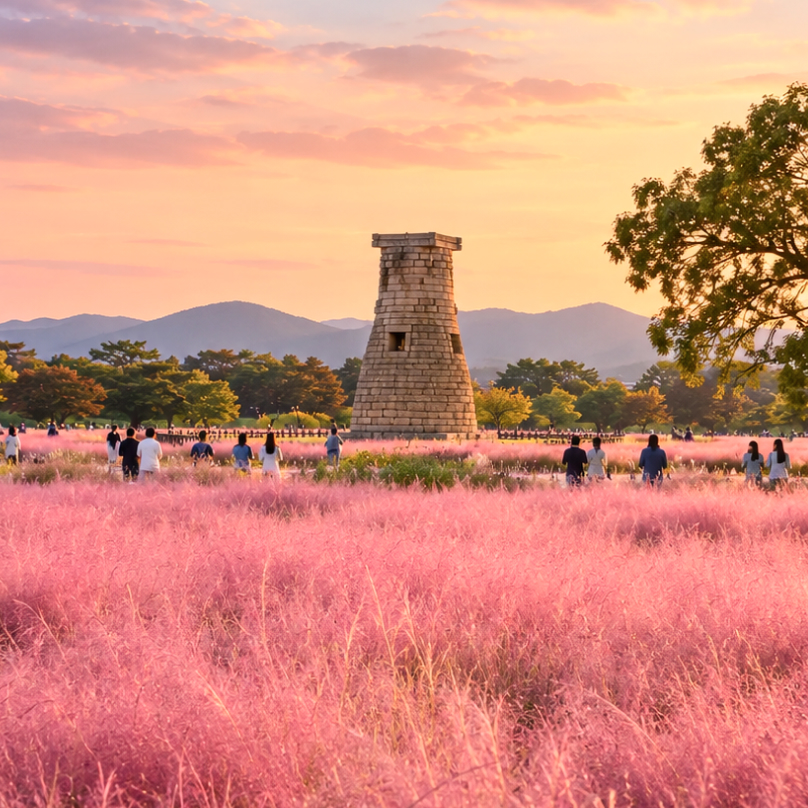
If you've walked through Seoul's autumn, board the KTX and head down to Gyeongju, the thousand-year-old ancient capital. Take a city bus from Gyeongju Station and get off at the "Cheomseongdae" stop, and an observatory about 9m tall, made of stones stacked in a rounded form, catches your eye first. This is Cheomseongdae (첨성대), believed to have been built during the reign of Queen Seondeok of Silla. At its foot lies a pink muhly field of about 4,200㎡, planted by the city of Gyeongju in 2017. An observatory more than a thousand years old standing behind 80,000 pink muhly plants. It's a place where something very old and something relatively new fit into a single photo. Pink muhly isn't the only thing here. Around Cheomseongdae, about 100,000 purple Brazilian vervain plants bloom from June to October, followed by cosmos, zinnias, and even sunflowers through the seasons. The pink muhly here shows its deepest pink between late September and mid-October. The field is open 24 hours with no admission fee, so after enjoying the flowers, take a slow walk along the rounded ridges of the ancient tombs to Wolseong, Gyerim, and Daereungwon.
Location
- 경주 동부사적지대 핑크뮬리 군락(Gyeongju Dongbu Historic Site Pink Muhly Field): 경북 경주시 인왕동 839-1 일원(next to Cheomseongdae)
Hours
- Pink muhly field open 24 hours
- Cheomseongdae viewing 09:00–21:00 (winter season)
- Open year-round
Admission
- Free admission
Getting There
- From KTX Gyeongju Station (경주역), take city bus No. 60 → get off at the "Cheomseongdae (첨성대)" stop
- Bus No. 61 and Woljeong 3 also stop at the same stop
Suggested Route
- Cheomseongdae and the pink muhly field
- Brazilian vervain field around Cheomseongdae
- Gyerim → Woljeonggyo Bridge
- Allow more than 1 hour to visit Gyerim and Woljeonggyo Bridge
- Daereungwon and Donggung Palace and Wolji Pond charge admission (adults KRW 3,000)
PICK 4
Chrysanthemums by the Harbor,
Masan Gagopa Chrysanthemum Festival
Masan Gagopa Chrysanthemum Festival
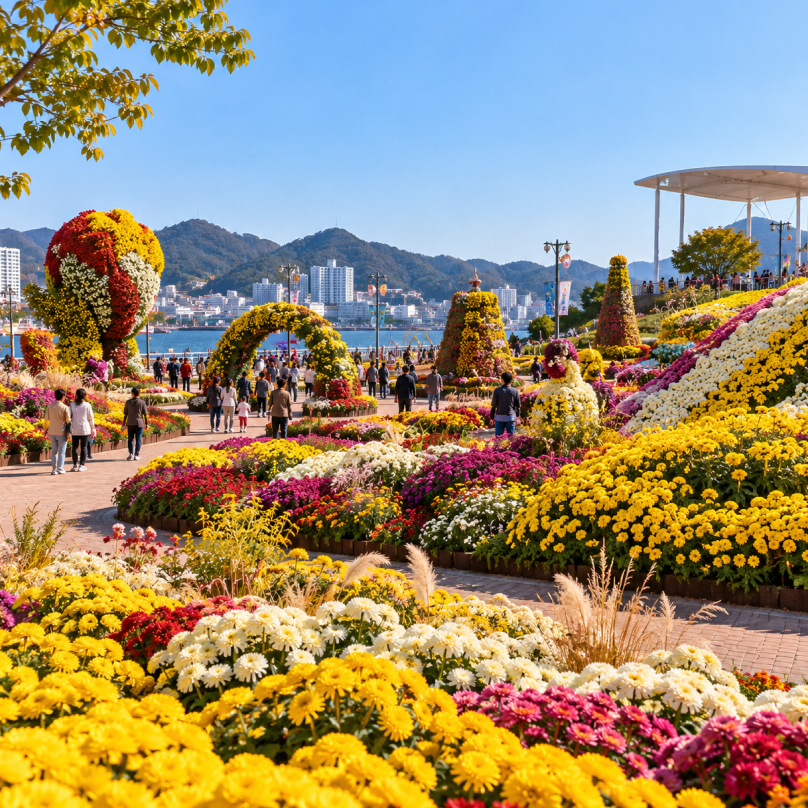
If you've walked the flower paths of the ancient capital, shall we head to a flower festival by the southern sea next? Masan is a city of the sea and its fish market. But when autumn ripens, the scent of chrysanthemums replaces the smell of fish in this harbor for nine days. Now in its 26th year, the Masan Gagopa Chrysanthemum Festival (마산가고파국화축제) fills about 2.3km of coastal walkway along Masan Port with some 100,000 chrysanthemums. With about 900,000 visitors last year alone, it's one of the festivals that best represents autumn in Korea. By day, walk among yellow and red chrysanthemums with the sea beside you. A chrysanthemum bonsai exhibition, carefully tended by hand, is also held, so you can take your time admiring the shape of each plant. After sunset, a multimedia fireworks show and a fire-drop performance over the sea, where sparks rain down onto the water, carry on into the night. This year's festival runs from October 31 to November 8. Take your time enjoying the autumn scenery created by the sea and the chrysanthemums together.
Location
- 제26회 마산가고파국화축제(26th Masan Gagopa Chrysanthemum Festival): 경남 창원시 마산합포구 월남동1가 46-3(around 3·15해양누리공원)
Hours
- Masan Gagopa Chrysanthemum Festival(마산가고파국화축제): Oct 31 (Sat)–Nov 8 (Sun), 2026, 09:00–21:00
- Performances 10:00–22:00
Admission
- Free admission
Getting There
- From KTX Masan Station (마산역), take city bus No. 72 → get off at the "Eosijang (어시장)" stop and walk toward the coast of 3.15 Marine Nuri Park
PICK 5
A Pink Path Along the Nakdonggang River,
Busan's Daejeo Ecological Park
Busan's Daejeo Ecological Park
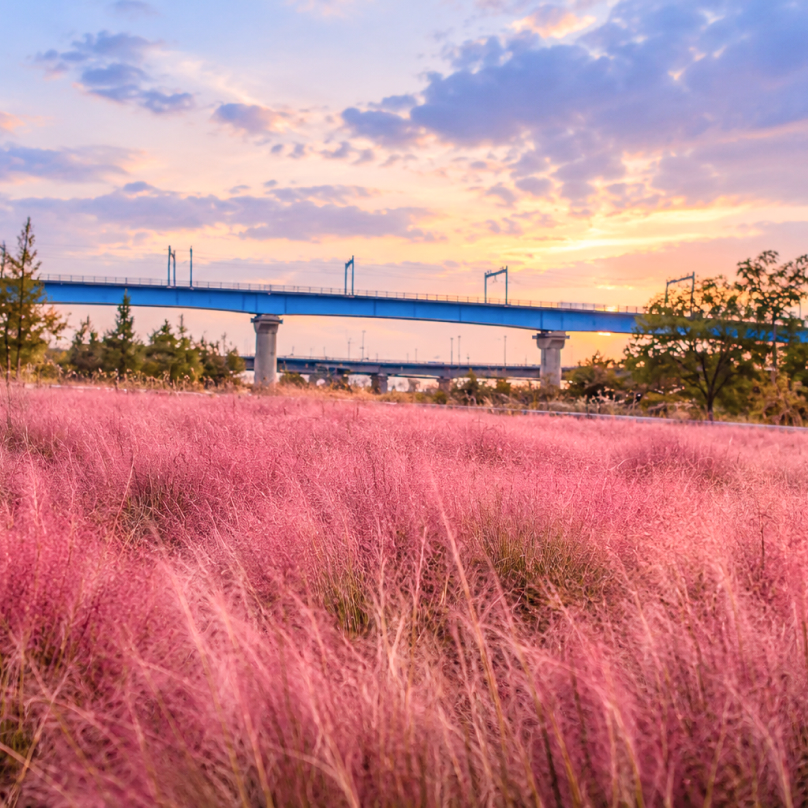
Carrying the scent of chrysanthemums on to Busan, another flower path awaits, stretching long along the Nakdonggang River. Walk about 20 minutes from Gangseo-gu Office Station toward the river, and the sky widens as the riverbank stretches endlessly ahead. Daejeo Ecological Park (대저생태공원) is a riverside park covering 3.43㎢ and stretching 7.62km, about 15 times the size of Seoul's Yeouido Park. In spring, about 370,000㎡ of this riverbank is blanketed in yellow canola flowers; in autumn, it changes into three kinds of flowers: pink muhly, silver pampas grass, and orange sulfur cosmos. The pink muhly runs for about 1,000m between Gupo Bridge and Gupo Nakdonggang Bridge, and the wide field near Parking Lot 2 blends with a bamboo forest trail, so the scenery shifts little by little as you walk. The pampas grass, growing taller than a person and swaying silver, and the quiet reed beds also keep making you stop. Since the park stretches so far, renting a bike is a great way to explore, and as it extends toward Gimhae International Airport, it's worth adding as an afternoon walk on the day you arrive in or leave Busan.
Location
- 대저생태공원(Daejeo Ecological Park): 부산 강서구 대저1동 1-5 일원
Hours
- Always open
- Open year-round
Admission
- Free admission (free parking)
Getting There
- Busan Metro Line 3 Gangseo-gu Office Station (강서구청역) Exit 1 → about 20 min walk
Suggested Route
- Pink muhly field and bamboo forest trail near Parking Lot 2
- Pink muhly path between Gupo Bridge and Gupo Nakdonggang Bridge (about 1,000m)
- Pampas grass field near Parking Lot P4
- About 1km between P2·P3 (pink muhly) and P4 (pampas), so a bike is handy
PICK 6
A Volcanic-Stone Path Beneath Hallasan,
Jeju's Hueree Natural Park
Jeju's Hueree Natural Park
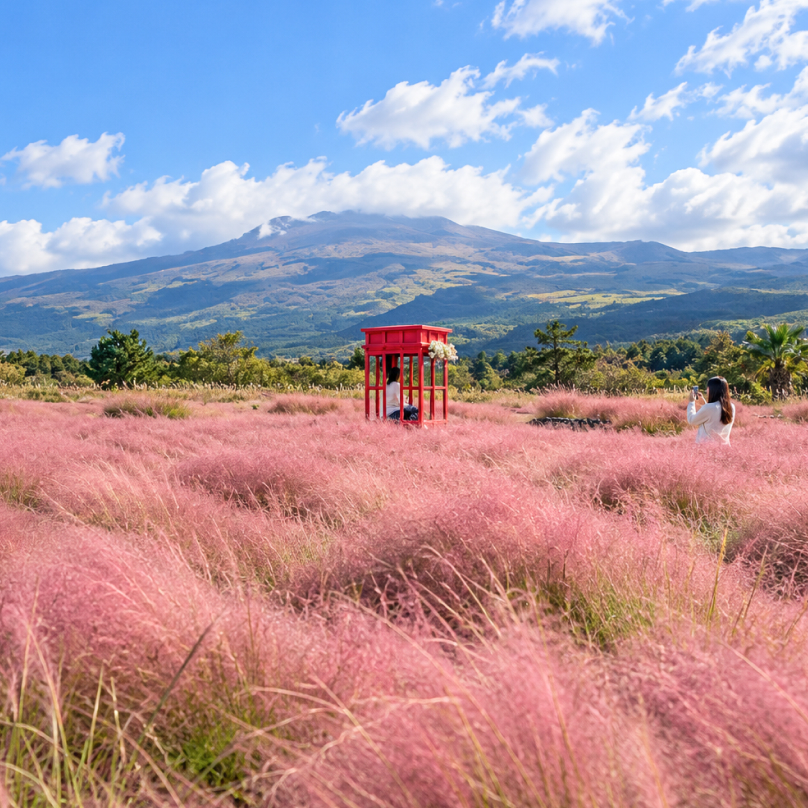
Our final stop is Jeju, across the sea. Board a plane and head for the foot of Hallasan Mountain. Take a bus from downtown Seogwipo and get off at the "Hueree Natural Park" stop, and a path paved with dark red Jeju volcanic scoria leads into the garden. Hueree Natural Park (휴애리 자연생활공원) is a garden that holds a flower festival every season against the backdrop of Hallasan, and in autumn it hosts its Pink Muhly Festival (핑크뮬리 축제). The Sky Garden, the Palm Forest Garden, and the Cafe Garden. Pink muhly blooms in each area, so you can enjoy a tropical-looking scene where palm trees and pink waves fit into one frame. Pink spreading over a black volcanic-stone path. Jeju's pink muhly is at its loveliest from mid to late October. Chrysanthemums bloom in October and November, and from November red camellias take over, so flowers never stop even as the seasons change. During harvest season, there's tangerine picking and a black pig show too, making it a great spot to visit with kids. From October, last entry moves up to 4:30 p.m., so plan to drop by in the morning or early afternoon with plenty of time.
Location
- 휴애리 자연생활공원(Hueree Natural Park): 제주 서귀포시 남원읍 신례동로 256
Hours
- 09:00–18:00 (last entry 16:30 from October)
- Open year-round
- Pink Muhly Festival(핑크뮬리 축제): Sep 14–November, 2026
Admission
- Adults KRW 13,000
- Youth KRW 11,000
- Children KRW 10,000
- On-site prices; booking online is about 10% cheaper
- Tangerine picking and other activities are charged separately
Getting There
- From downtown Seogwipo (via Jungang Rotary), take branch bus No. 623 → get off at the "Hueree Natural Park (휴애리 자연생활공원)" stop
Suggested Route
- Pink muhly in the Sky Garden, Palm Forest Garden, and Cafe Garden
- Tangerine picking (harvest season)
- Black pig show (on the hour 10:00–17:00, except 12:00)
- About 1 hour for photos only, 1.5–2 hours including activities and the show
Capturing the autumn light on a pink hill beneath Hallasan, we bring our journey to a close. Silver grass on a hill that was once a landfill, pink muhly beside a Baekje earthen fortress and a Silla observatory, chrysanthemums filling a harbor, and pink along a volcanic-stone path. Each of Korea's autumn flowers blooms on top of an old story. Is there any other country that greets autumn with so many different faces? This autumn, why not take your time walking a flower path of your own?
How about it? Are you looking forward to your trip to Korea?
And have you decided what kind of internet to use for your trip? The answer is simple: go with LG U+'s prepaid 5G SIM.
"Conclusion: 5G is simply more convenient during your trip.
And with 010 voice service, your trip to Korea gets even better."
- Feel the speed difference instantly
- Exceptional stability in busy locations
- Enhances the overall experience, from travel documentation and work to navigation
- Beyond data, more varied experiences through 010 voice service for transport, food, and delivery
Enjoy your trip to Korea
even more with LG U+ 5G eSIM
even more with LG U+ 5G eSIM


